
i love you, i say / i know, you say
Season 4, Episode 6, London, 2024
[Text by Antonia Blocker]
Ultimately I don’t approve of Ahren Warner’s work. I don’t approve in the same way that I don’t approve of smoking cigarettes and attending expensive yoga classes led by young white women and going on package holidays to countries compromised by the climate crisis and overriding the self-imposed daily time limit on my Instagram app. And yet, I’ve been enticed by all those things before.
Warner’s work reveals and revels in the critiqued yet persistent aesthetics of a particular cis-het fantasy of wealth, sex and beauty, fuelled by social media. To make it, Warner seeks out the hyper-capitalist, self-indulgent, toxic spaces of party hostels, yoga retreats and co-living spaces, frequented by largely young, white Westerners. He makes work by immersing himself within these contexts in a way that feels questionable, but only to the extent that the alternative of pure observation would be more so; exploitative and voyeuristic even to those who are so readily exposing themselves. His work speaks to the desire for a lavish and somewhat gross fantasy which, from an ‘enlightened’ perspective, is easy to dismiss and claim no interest in. Yet his work inserts a niggle of doubt into any sense of self-assured rising above. This may not be your fantasy, but you fantasise nonetheless.
In his new exhibition i love you, you say / i know, they say, this visual source material of the party hostel remains present in the three-channel film Into that lightening, almost glade. Yet, in this scenario it becomes abstracted, the footage a barely legible backdrop to the Insta-story text overlay. Repeating across three screens hung in portrait - like giant iPhones - the narrative conveys a fantasy, or dream, or both; of sex, or wealth, or both. The protagonist of this fantasy - or dream - wavers in an indecipherable shadow-space, the narrator, the ‘you’, the ‘I’ and the ‘they’, unclear and conflated. Who holds the agency here between artist, subject and viewer?
This confusion is important: as in the fiction of fantasy, we play all the roles, with no space for the agency of others, whether in confrontation or intimacy. To quote another masc fantasy character: You talkin' to me? Then who the hell else are you talking... you talking to me? Well I'm the only one here.
Warner’s film forms part of an installation that shares its name with the show, which also features large-scale images of hairless costumed cats and hyperreal semi-naked women accompanying a buff, bearded semi-naked man. Mimicking the same oversize iPhone format as the film screens, these images are high-res, re-photographed Instagram images, sublimation printed on ‘shimmer velvet’. Rather than a Richard Prince-esque confrontation of intellectual property, this high-spec, labour-intensive process renders the works as tangible ‘rich images’; a subversion of Hito Steyerl’s ‘poor image’, the ripped, recirculated jpeg.
Written a year after the release of the first-generation iPhone, and a year before the advent of Instagram, ‘In Defense of the Poor Image’ seems almost quaint from a contemporary perspective. How could Steyerl have foreseen the ‘pile of stuff’ that populates our social media streams? Images that fuel not only our aspirational fantastical desires for the interrelated trifecta of power, sex and money, but also our everyday need for feline placation in the face of the former’s improbability.
These works embody the difficult conundrum that fuels Warner’s practice; they are both off-putting in their representation of an extreme social media irreality, and glistening, desirable luxury objects. Rendered luscious through their materiality, the two subject matters create a strange cognitive dissonance. The visuals of a hyper-capitalist masc dream of mega-wealth through little labour, all while surrounded by a gaggle of toned women, is rendered ridiculous and pathetic in the context of the hairless cats. The cats themselves – the opposite of kawaii – become perverse. Their baldness, in dialogue with the other images, becomes suggestive of a bizarre and slightly grotesque nudity.
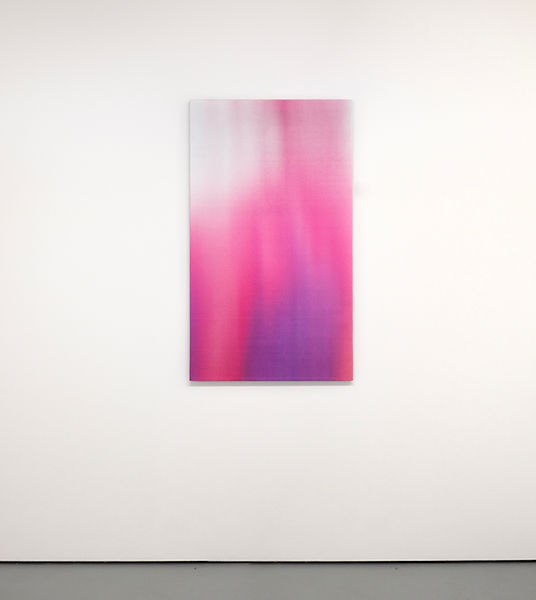
Downstairs, a series of sublimation prints entitled High Fidelity, or I play your furies back to me at night complete a kind of feedback loop of rich-image-poor-image. Gleaned from the film and pictures upstairs, the highly edited details become abstracted pools of flesh and jewel tones. The colour and composition are pushed almost to the point of illegibility, however this renders them more, not less, seductive. Like a game of broken telephone, the narrative breaks down further and further, becoming more and more abstract until you can no longer see the forest for the trees. What was the fantasy, whose fantasy was this? Am I appalled or enthralled?
This process of abstraction and seduction undermines the expected experience of easy distancing. While I doubt the glistening pectorals and glossy extensions of influencer yacht-life are the fantasy of a typical artworld audience, what if these images were to reform into another social media aspiration? If these digital compositions were to coalesce into the free-beer bucket of a PV, or a Venice palazzo invite-only party, or a comped post-Basel dinner, would the fantasy become more recognisable? The unsettling nature of Warner’s work asserts itself through his aversive subject matter, but it lingers in this suggestion of complicity. The systems of late-stage capitalism are so entrenched that we consider them to be neutral ground. We believe it’s possible to freely aspire, fantasise, exist in ways that can be deemed as right or wrong. Yet we are all entangled. Collusion and judgement might be uneasy bedfellows, but they are both spending the night.


